Excel Template for Interest Calculator

This Excel Interest Calculator template is designed to help you visualize the potential growth of your savings over time.

By using the built-in ‘FV’ (Future Value) function, it shows you the total amount of money you could have at the end of a specific period, taking into account your starting money, any regular savings you make, and the power of earning interest.

Click here to go directly to the download.

Use this tool to plan for future goals and see how consistent saving and compounding can work for you!

Short Introduction of the Interest Calculator

Download the file, open it with Excel and enter your

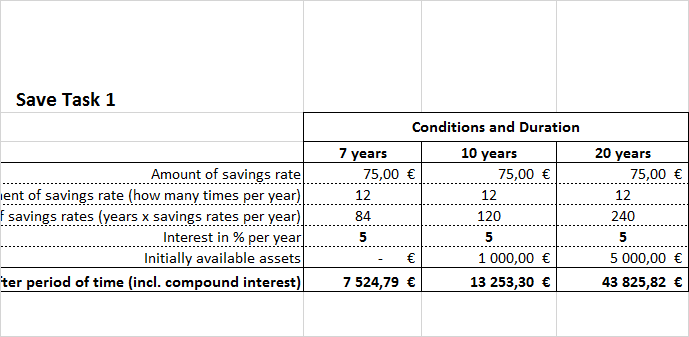
  1. savings rate (how much money you will save per month),
  2. the savings period (years and how many times per year- if not monthly)
  3. the interest rate,
  4. your initially available assets (optional)
  5. and Excel will calculate your savings after the saving period.

The number of savings rates and the final results will be automatically calculated. These cells have a gray background color – so don’t change them or put in own data.

Increase your interest rate, and you will immediately see how much faster you could reach the result of being a millionaire.

Now we just need a secure system that really creates a high interest rate πŸ™‚

By the way – there is a daily interest excel template on our site, too.

Take a look at the Screenshot of the Interest Calculator Excel Template

Excel template for the calculation of interest and compound interest

Excel template for the calculation of interest and compound interest

Download the Interest Calculator Excel Template for Free

If you like my templates, I’m looking forward to a little donation πŸ™‚

paypalpixel

How Does the Template Work?

In this Excel file, the FV function is used in the final cells to calculate the results.

Using the FV function to calculate interest over time

What “FV” Stands For:

FV just means “Future Value”.

What the FV Function Does:

Think of it like a financial crystal ball for your savings.

You tell it:

  1. How much money you start with (Your “Money at the beginning”).
  2. How much money you plan to add regularly (Your “Monthly savings rate”).
  3. How long you’ll let it grow (Your “Time in years”).
  4. How fast it grows (Your “Interest rate”).

And the FV function calculates the total amount of money you will have at the very end of that time period, assuming you keep making those monthly savings and your money keeps earning interest.

It’s More Than Just Adding Everything Up!

The clever part is that it doesn’t just add your starting money + all your monthly payments. It also calculates all the interest your money earns over the years, and crucially, the interest on that interest! This is called compounding, and it’s what makes your money grow faster and faster over time. The FV function figures out this powerful compounding effect for you.

What’s it Good For?

The FV function is incredibly useful for:

  • Setting Savings Goals: Want to save for a down payment on a house, retirement, or a big purchase? You can use FV to see if you’re on track with your current savings plan and time frame.
  • Seeing the Power of Saving: It clearly shows you how much your money can potentially grow thanks to interest, especially over long periods. This can be very motivating!
  • Comparing Scenarios: You can quickly see the impact of saving a little more each month, waiting longer, or getting a different interest rate on your final total.

In a Nutshell:

The FV function is a powerful tool that takes your initial savings, your regular contributions, the time, and the growth rate, and calculates the grand total you’ll have in the future, including all the earnings from compounding. It’s your go-to for figuring out the future value of your savings plan!

    Leave a Comment

    Pin It on Pinterest